
- 8556 120 Street, Surrey, BC.
- +12368082270
- 8556 120 Street, Surrey, BC, Canada
- info@thesuccessnavigators.ca
- +1-604-399-5300

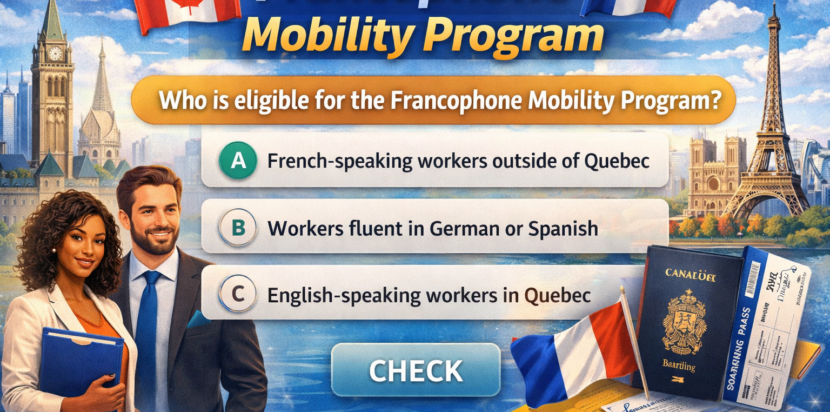
The Francophone Mobility Program is a Canadian immigration initiative. It aims to attract French-speaking skilled workers to different provinces and territories outside Quebec. The program simplifies the process for employers who want to hire French-speaking foreign nationals. It does not require a Labour Market Impact Assessment (LMIA) for eligible positions.
Through this program, Canada hopes to promote the use of French in minority communities. The program supports the country’s goal of increasing Francophone immigration outside Quebec. This helps strengthen the social and economic fabric of Francophone communities across Canada.
One key feature of the Francophone Mobility Program is its flexibility. Qualified employers can hire French-speaking workers for any skilled occupation (TEER 0, 1, 2, or 3). The candidate must demonstrate proficiency in French for their main daily tasks at work. Job offers under this program must be outside the province of Quebec.
Applicants do not need to submit an LMIA. This reduces wait times and administrative barriers for both employers and applicants. To qualify, candidates must provide proof of French language ability, like results from a recognized language test. The worker must be able to communicate in French both orally and in writing.
The Francophone Mobility Program offers many benefits for both workers and employers. Workers get a chance to gain Canadian work experience and possibly qualify for permanent residence later. Employers access a pool of talented French-speaking professionals, supporting their business growth and diversity goals.
The program also contributes to the vitality of Francophone communities outside Quebec. By facilitating the arrival of French-speaking newcomers, the program enriches the cultural and linguistic diversity of Canada. This aligns with the government’s broader goals related to bilingualism and multiculturalism.
| Feature | Description |
| Target Group | French-speaking skilled workers, excluding Quebec |
| Language Requirement | Proficiency in French (oral and written) |
| LMIA Needed? | No |
| Employer Requirement | Job offer must be outside Quebec |
| Occupation Eligibility | TEER 0, 1, 2, or 3 (skilled occupations) |
To join the Francophone Mobility Program, candidates must meet certain core criteria. The participant must be proficient in French. French language skills are essential, as this program aims to promote Francophone culture and communication in Canada. Applicants must also have a valid job offer outside Quebec. The job offer must be for a position listed as skilled work under the National Occupational Classification (NOC) system. Age is not a strict barrier, but candidates need to be adults who can legally work in Canada. Legal admissibility to Canada is a fundamental condition for all potential participants.
A table summarizing the main eligibility points:
| Criterion | Requirement |
| Language | Proficiency in French |
| Job Offer | Valid, outside Quebec |
| Work Classification | Skilled (NOC) |
| Age | 18 or older |
| Legal Status | Admissible to Canada |
The Francophone Mobility Program has additional criteria that set it apart. The job must be with an employer outside Quebec. This requirement is to promote Francophone presence across other provinces and territories. Proof of French language proficiency is determined by employer evaluation or official language test results. Employers will often conduct interviews or require language certificates. Applicants must show they intend to work and live in a Francophone minority community outside Quebec. The intent is confirmed by the location of the job and supporting documents.
The program is open to a range of professions. The list of eligible jobs covers management, technical, professional, and skilled trades roles. However, all positions must align with the criteria set in the National Occupational Classification.
Certain roles and situations are not eligible for this program. Jobs located in Quebec do not qualify. Participants who cannot prove French proficiency will not be accepted. Temporary positions under low-skilled categories are typically not included. Candidates must ensure their application and supporting documents meet all requirements. Failing to provide accurate and complete information may lead to delays or rejections. Understanding these eligibility criteria helps potential participants prepare a strong application for the Francophone Mobility Program.
The Francophone Mobility Program is open to foreign nationals who speak French fluently. It targets applicants intending to work outside Quebec. The program requires a valid job offer from a Canadian employer. Candidates must demonstrate their French proficiency through recognized language tests. Employers do not need a Labour Market Impact Assessment (LMIA) for positions under this program. This removes a significant barrier for both employers and applicants.
Participants must plan to work in a province or territory outside Quebec. The program is not available to those seeking jobs in Quebec. Both skilled and semi-skilled positions are eligible under this stream. The focus is on encouraging French-speaking immigration to all regions of Canada except Quebec.
Applicants must secure a job offer before applying for a work permit through the Francophone Mobility Program. After obtaining a job offer, they can apply for an employer-specific work permit. The process is streamlined because no LMIA is required. This speeds up the application timeline for both employers and workers. Applicants can include accompanying family members in their application.
The program offers a pathway to permanent residence for eligible candidates. Work experience gained in Canada can help applicants qualify for programs like Express Entry. The program aims to boost French-speaking communities across Canada. It also supports the government’s goal to attract more French-speaking immigrants outside Quebec.
Most occupations are eligible for the Francophone Mobility Program. Jobs can range from management and professional roles to technical and skilled trades. Certain positions, such as primary agriculture, are not eligible under this program.
Applicants must provide proof of French proficiency at an intermediate level. Acceptable tests include TEF and TCF. This ensures that candidates can function in French at work and in the community. The language requirement is central to the program’s goal of strengthening francophone communities outside Quebec.
| Feature | Details |
| Language Requirement | Intermediate French proficiency |
| LMIA Requirement | Not required |
| Eligible Occupations | Most NOC codes except primary agriculture |
| Target Region | All provinces and territories except Quebec |
| Pathway to Permanent Residence | Yes |
This section presents multiple choice questions to test your knowledge about the Francophone Mobility Program. Review each question and select the most appropriate answer. These questions cover program eligibility, benefits, and application details. Use this practice to assess your understanding of the main features of the program.
| Question | Choices |
| 1. What is the main goal of the Francophone Mobility Program? | a) To promote French language b) To sponsor students c) To provide job offers d) To speed up citizenship |
| 2. Who is eligible to apply for the Francophone Mobility Program? | a) Any French speaker b) Permanent residents only c) French-speaking foreign nationals d) Canadian citizens |
Carefully read each choice before selecting an answer. These questions will help reinforce key aspects of the Francophone Mobility Program. They focus on real scenarios that applicants may encounter.
The following MCQs evaluate your grasp of specific requirements within the Francophone Mobility Program. Understanding requirements is crucial to a successful application. These questions highlight language abilities, job offers, and regional criteria.
| Question | Choices |
| 3. What language proficiency is required for the program? | a) Basic English b) Advanced French c) No requirement d) Intermediate Spanish |
| 4. Which Canadian regions does the program encourage migration to? | a) Only Quebec b) Non-Francophone regions c) All regions d) Ontario only |
Each question targets a different program criterion. Review your answers to make sure you understand eligibility and regional focus. Mastering these will improve your chances of success in the application process.
This part focuses on the application process and potential outcomes for Francophone Mobility Program participants. The questions test your awareness of documentation, processing times, and post-arrival expectations.
| Question | Choices |
| 5. What document is required to apply? | a) Proof of funds b) Valid job offer c) Canadian citizenship d) English test certificate |
| 6. What is an expected benefit of the program? | a) Free housing b) Faster work permit processing c) Immediate permanent residence d) Scholarship grants |
Understanding these questions will help applicants prepare better. These MCQs are designed to shed light on the important steps in the process and what participants can expect once approved.
The Francophone Mobility Program offers a pathway for French-speaking individuals to work and gain experience in Canada. Its focus is on attracting skilled workers from Francophone countries outside Quebec. The program features a streamlined process, particularly for eligible occupations. MCQ (Multiple Choice Questions) are often used in assessments to gauge applicants’ understanding and readiness.
Success in the MCQ portion increases the chance of progressing through the application. The demand for French-speaking talent continues to grow in Canada, making this program important for both newcomers and employers. Individuals who prepare well for the MCQ component gain a competitive edge. The program not only addresses labor shortages but also promotes Canada’s linguistic diversity.
The Francophone Mobility Program has a positive impact on Canadian society. It supports economic growth and helps newcomers integrate through employment. MCQ-based assessments help ensure candidates meet language and job-specific requirements. Employers benefit from access to a diverse pool of skilled labor.
Recent policy updates aim to improve the program’s efficiency and broaden its reach. Technology is playing a larger role in the MCQ process, making it more accessible for applicants. Changes are regularly introduced to better align with Canada’s labor market needs and national priorities. Continuous improvements help maintain the program’s relevance and effectiveness.
The future of the Francophone Mobility Program appears promising. Demand for bilingual professionals is expected to rise in various sectors. More digital resources could be integrated into the MCQ process to support applicants. Prospective participants should focus on enhancing their French language skills and understanding Canadian workplace culture.
Ongoing collaboration between immigration authorities and employers will drive further innovation. The program is likely to expand its scope or adapt its criteria to meet new challenges. Staying updated with policy changes and preparing thoroughly for the MCQ assessments remains crucial for future applicants.