
- 8556 120 Street, Surrey, BC.
- +12368082270
- 8556 120 Street, Surrey, BC, Canada
- info@thesuccessnavigators.ca
- +1-604-399-5300

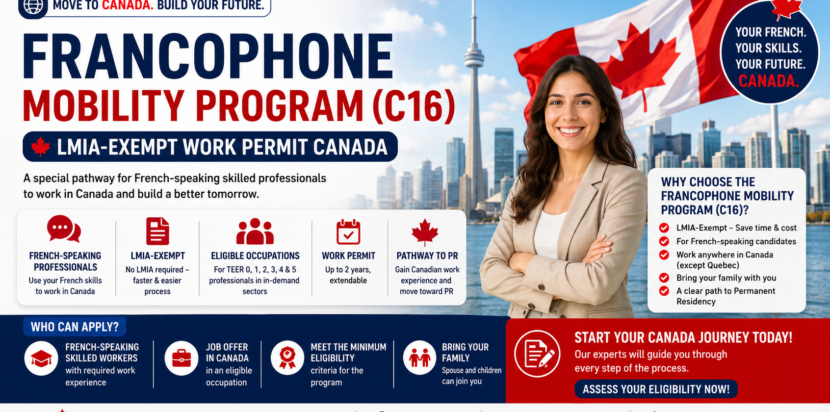
The Francophone Mobility Program (Mobilité Francophone), operating under LMIA exemption code C16, is one of Canada’s most accessible and strategically important work permit pathways for French-speaking foreign nationals. Administered under the International Mobility Program (IMP) by Immigration, Refugees and Citizenship Canada (IRCC), this program allows Canadian employers to hire qualified French-speaking workers without the cost, delay, or administrative burden of a Labour Market Impact Assessment (LMIA). If you are a French-speaking professional looking to build your career in Canada, or a Canadian employer seeking to hire French-speaking talent quickly, the C16 pathway could be the most efficient route available. The Success Navigators can guide you through every step of the process.
The Francophone Mobility Program is authorised under R204(c) of the Immigration and Refugee Protection Regulations (IRPR) and advances Canada’s official languages policy by strengthening Francophone minority communities in provinces and territories outside Quebec. Unlike LMIA-dependent streams under the Temporary Foreign Worker Program (TFWP), the C16 pathway eliminates the labour market test requirement entirely — enabling expedited hiring and faster work permit issuance for both employer and applicant.
There is no job advertisement requirement under this program. Employers are not required to demonstrate that they attempted to hire a Canadian citizen or permanent resident first — a significant advantage over standard LMIA-based hiring processes. If you have questions about how this compares to other work permit pathways, contact our immigration team for a personalised assessment.
The C16 exemption covers all NOC TEER categories (0, 1, 2, 3, 4, and 5), with a single statutory exclusion: primary agriculture occupations classified under TEER 4 or 5 are ineligible. This broad occupational coverage makes C16 one of the most versatile work permit pathways in Canada’s immigration system, applicable across industries from tech and finance to healthcare, education, and hospitality.
⚠️ Critical Timing Requirement
The employer job offer must be submitted to the IRCC Employer Portal under code C16 before the worker applies. An application submitted without a valid, prior employer portal submission will be refused. Simultaneous submissions are treated the same as late submissions.
The Francophone Mobility Program is not just a temporary work solution — it is often a strategic first step on the road to Canadian permanent residency. Canadian work experience gained under a C16 permit contributes directly to your Comprehensive Ranking System (CRS) score in Express Entry, and qualifies you for French-language category draws which have been held at very competitive score thresholds. Learn more about navigating your path to permanent residency in Canada and how The Success Navigators can map out your full immigration roadmap.
No. The Francophone Mobility Program is explicitly LMIA-exempt under R204(c) of the IRPR. The employer is only required to submit a compliant offer of employment through the IRCC Employer Portal with code C16 and pay the CAD $230 employer compliance fee. No labour market test is required.
No. IRCC accepts multiple forms of evidence, including official TEF Canada or TCF Canada test results, post-secondary transcripts, diplomas, or written confirmation letters from a French-language educational institution. The key requirement is demonstrating NCLC Level 5 in speaking and listening.
Yes, provided the job offer is for six months or longer. Your spouse or common-law partner may apply for a Spousal Open Work Permit (SOWP), which allows employment with virtually any Canadian employer. Read our full guide on how to apply for a Spousal Open Work Permit in Surrey.
Unfortunately, the Francophone Mobility Program is specifically designed to strengthen French-speaking communities outside Quebec — positions in Quebec are not eligible under code C16. There are Quebec-specific immigration streams worth exploring in that situation. Contact us and we will help identify the right pathway for your profile.
No. The C16 permit is employer-specific. A change of employer requires a new work permit application, with the new employer completing a fresh Employer Portal submission under code C16 and paying the compliance fee. Our team can help coordinate this transition — learn how our consultants can help you secure your Canadian work permit.
Yes. Foreign nationals already in Canada whose work permits are nearing expiry may apply for a work permit extension under C16, provided all eligibility criteria are met and a valid employer portal submission is in place before submitting the extension application. IRCC recommends applying at least 45–60 days before your permit expires.
Common grounds include: incorrect or missing LMIA exemption code (must be C16); employer job offer submitted after or simultaneously with the worker’s application; insufficient proof of French proficiency; position in excluded primary agriculture TEER 4–5 occupations; or the intended work location being in Quebec.
Whether you are an employer looking to hire a French-speaking professional or an applicant ready to pursue the Francophone Mobility pathway, our Regulated Canadian Immigration Consultants (RCICs) at The Success Navigators are here to guide you every step of the way — from Employer Portal submissions and proficiency documentation to work permit applications and long-term PR planning.
Contact The Success Navigators today for a free consultation and let us help you navigate your Canadian immigration journey with confidence.
Disclaimer: This article is provided for informational purposes only and does not constitute legal or immigration advice. Immigration regulations and IRCC policy are subject to change. Consult a Regulated Canadian Immigration Consultant (RCIC) or licensed immigration lawyer prior to submitting any application.